
Understanding Kankakee County Releases
“Released” describes the end of one custodian's control, not always the end of all custody. A person can leave Jerome Combs Detention Center after a court-authorized community release, completion of a county term, or credit for time served. The same exit may instead be a transfer under an IDOC mittimus, another county's warrant, or federal authority. A mittimus is the court order directing a jailer to deliver a person to prison. The person's name may vanish from a local roster in each case, but only some paths return the person to the community.
Kankakee County released inmate records must therefore be read by lifecycle. The county booking record tracks arrest, intake, housing, bond or pretrial details, court events, and the local exit. An IDOC commitment record begins after a state sentence and can continue through prison, mandatory supervised release, and final discharge. The court file supplies the legal basis but is not a movement log. Strong confirmation pairs the Sheriff's actual timestamp with the matching court order, then checks the next custodian when a transfer is recorded.
- Discharge
- The completed end of a custodian's authority or, in IDOC usage, the end of the commitment.
- Time served
- A sentence completed with credit for time already spent in custody.
- Transfer
- Movement to another agency while custody continues.
- MSR
- Mandatory supervised release, an IDOC community-supervision period after prison.
Kankakee County Release Paths
The record's exact wording matters. Illinois now uses pretrial release rules for new proceedings, while older Kankakee records may still use bond terms. A dismissal can explain a court result without proving when jail processing ended. Probation is a court sentence usually supervised through the county, while parole or MSR follows an IDOC prison term. An escape or death also ends ordinary jail housing but must never be described as a routine community release.
| Recorded event | What it means | Best next record |
|---|---|---|
| Pretrial or bond release | Community release ordered in the criminal case, subject to any other hold | Sheriff discharge and Circuit Clerk order |
| Time served | County sentence ended with applicable custody credit | Judgment plus actual discharge time |
| Probation | Court-ordered community supervision | Court disposition and county probation record |
| IDOC commitment | Transfer into state custody, not release | IDOC profile and mittimus |
| Federal or other hold | Another custodian takes control | Receiving agency and relevant docket |
A scheduled date does not complete any of these events. The live Tyler detail separates “Release Date” from “Scheduled Release Date.” Holds, court orders, sentence calculations, and processing can change a plan. Use “actual release date and time” only when the custodian recorded the completed exit.
Kankakee County Release Record Fields
The public Tyler booking detail is broad. It can show a subject number, booking number and date, housing facility, prisoner type, charges, bond, court date, docket, disposition, sentence details, and both scheduled and actual release fields. Research tests in July 2026 found only results marked in custody, even when the “In Custody” box was cleared. That observation means the interface cannot be treated as a dependable archive of completed Kankakee County releases.
| Requested field | What it establishes |
|---|---|
| Booking or subject number | Links the request to the correct local custody event |
| Admission date and time | Marks when Sheriff custody began |
| Actual discharge or transfer time | Marks when local physical custody ended |
| Release authority or disposition | Records the stated legal or administrative basis, when maintained |
| Receiving agency | Distinguishes transfer from community release |
| Booking photograph | Identifies the image from that booking, if available |
Ask for the field in the existing record, not an opinion. A narrow request for one booking and date range is easier to locate than a demand for every record tied to a name. One discharged sentence count on an IDOC profile also does not close the whole commitment. Every count and the overall offender status must agree.
Request Kankakee County Release Records
The Kankakee County Sheriff's FOIA page is the direct historical path when a completed booking no longer appears online. The current office instruction is unusually specific: place an electronic request in the email body sent to foiakcso@kankakeecountyil.gov. Attachments and embedded links will not be opened or processed. An older county PDF lists a different email domain, so the current Sheriff page should control.
- Gather the booked name, approximate intake date, date of birth if safely known, booking or subject number, arresting agency, and docket.
- Ask for the actual discharge or transfer date and time, recorded authority, receiving agency, and related booking image in electronic form.
- Choose inspection, copies, or both, and state the preferred electronic format.
- If material is withheld, ask for the cited exemption and all reasonably segregable nonexempt fields.
- Compare the response with the Circuit Clerk order and the next custodian's record.
Kankakee County Sheriff, FOIA
3000 S. Justice Way
Kankakee, IL 60901
Phone: 815-802-7100
Fax: 815-802-7101
Illinois FOIA ordinarily allows the first fifty black-and-white letter or legal pages without a copy charge, then permits up to fifteen cents per page. Color, oversized, and electronic media charges may reflect actual reproduction cost. Commercial requests follow different timing rules. No public retention period for completed Tyler bookings was found, so the absence of an online result should lead to a written request rather than a conclusion.
Kankakee Release Records Under FOIA
Section 2.15 of the Illinois Freedom of Information Act identifies chronological arrest information for disclosure. For an incarcerated person, that set includes the date and time received, discharged, or transferred, along with a photograph when and if one is available. The law does not promise that every agency records a reader's preferred “release reason.” It also permits listed limits tied to pending cases, safety, and facility security.
Sealing and expungement change access. Expungement can physically destroy records or return them to the requester and remove the person's name from public official indices. Sealing generally restricts public access while specified agencies retain access. The Illinois Courts forms explain the petition process. A missing result can reflect interface limits, a sealed case, or a corrected identity, so it does not prove that no event occurred.
Find Released Kankakee County Inmates
Start with jurisdiction, not a broad name search. The Sheriff proves a physical county exit. The Circuit Clerk explains the order. IDOC proves state commitment, prison release, or later supervision. VINE provides notice drawn from participating agency feeds. BOP, USMS, and ICE cover distinct federal systems. Each source answers a narrower question, and two independent records often give the best result.
- Search the official Sheriff and Tyler roster for the local booking number and live status.
- Check Illinois VINE for the person or case and read “transfer” as continued custody.
- Use the Kankakee Circuit Clerk docket to find the release order, sentence, dismissal, probation, or mittimus.
- If a state sentence appears, search IDOC and match the Kankakee County sentence block.
- Call Corrections at 815-802-7200 for present physical custody, then request the completed Sheriff record for exact proof.
The Sheriff inmate-search landing page describes its current-custody tool and projected date field. The linked Tyler public-safety search provides Name, Subject Number, Booking Number, booking-date controls, an In Custody checkbox, and Housing Facility. Its observed results do not supply a genuine 24-hour release list.
IDOC Search for Kankakee Releases
The Illinois Department of Corrections offender search applies only after an IDOC commitment or to a former state prisoner. A Kankakee County jail release by itself does not create an IDOC profile. Search by last name, IDOC number, or birth date where the live form permits, then confirm that a sentence block identifies Kankakee as the committing county.
| IDOC field | How to read it |
|---|---|
| Offender Status | Overall state status, such as incarcerated, parole, or discharged |
| Location | Institution or parole district, not a county-jail location |
| Parole Date | Recorded prison release to community supervision |
| Projected Discharge Date | Expected later end of the state commitment |
| Sentence Discharged? | Status for one sentence count, which must be read with every other count |
The official live form is shown in the IDOC search entry point.
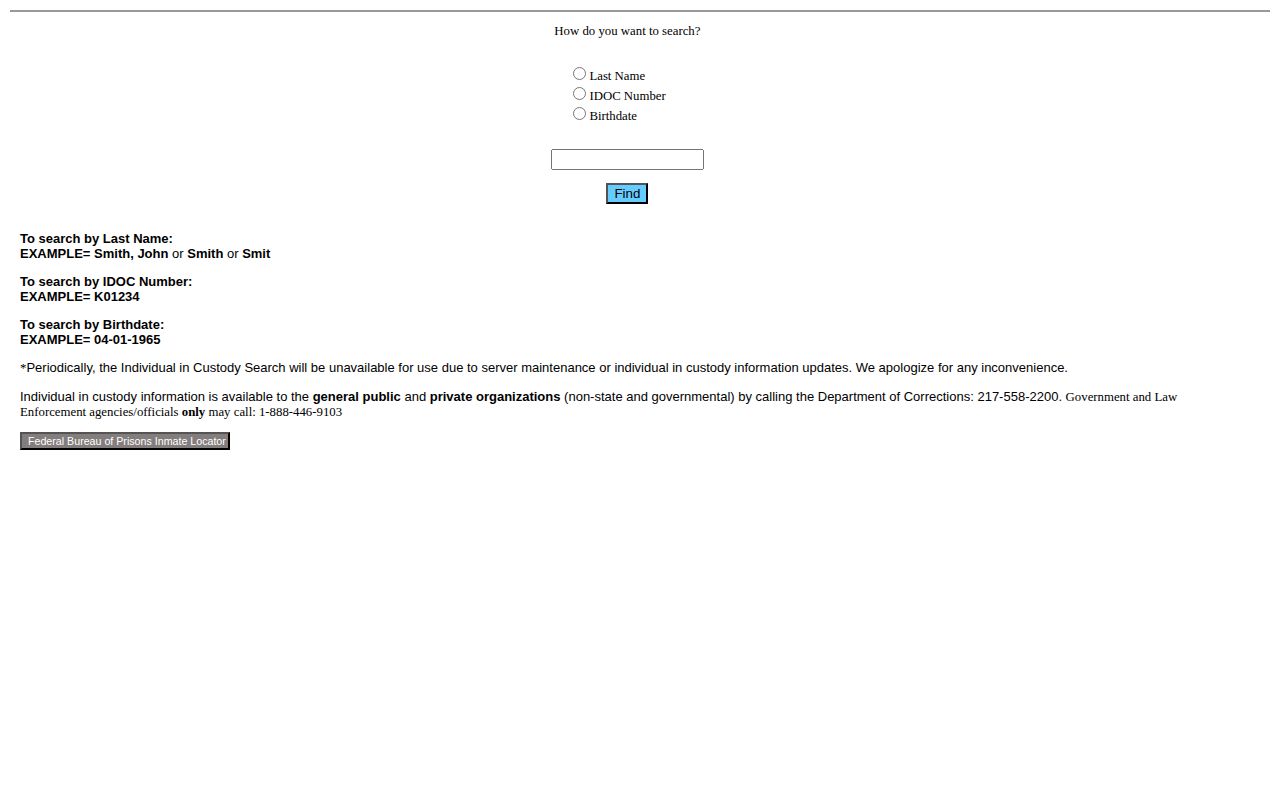
The form is a statewide source. Its status and dates should be captured with the retrieval date because sentence credit, court corrections, and agency recalculation may change a projected date.
Kankakee Holiday Release Timing
An official Sheriff incident report from November 2022 documents one person posting bond and leaving JCDC through the administrative lobby early on Thanksgiving afternoon. The event proves that holiday release processing occurred in that case and identifies that exit route. It does not establish a standard release hour, a daily public schedule, or a promise that another Kankakee County release will use the same door. Exact timing still comes from the completed discharge record.
Kankakee Release Court Preparation
Kankakee court records use the Tyler Enterprise Justice portal, which is separate from the Sheriff's Tyler public-safety roster. The criminal and expungement counter is in Room 209. County courthouse rules restrict electronic devices and provide security lockers, so an in-person visitor should gather a case number, party name, and needed notes before entering. The court file can explain a pretrial order, sentence, probation, dismissal, or mittimus, while the Sheriff's record remains the source for the actual physical exit time.
Kankakee Release Reentry Services
Kankakee County code created a Sheriff-supervised reentry coordinator position under state law. Local programs add practical help without changing a person's legal custody status. Kan-I Help describes “Living on the Outside” and Thinking for a Change programming at both detention centers and at the Reentry Services Office. Kankakee County Reentry Opportunity services include case management, mentoring, treatment referrals, and limited transit help. These resources can help someone prepare for life after a verified release, but they are not release locators or proof that a discharge occurred.
Kankakee's Former Mixed Custody
A 2020 ICE inspection documented a mixed JCDC population that included county, USMS, and ICE detainees. Illinois later ended county immigration detention agreements, and Kankakee's remaining ICE detainees left in February 2022. This dated history matters when reading older release records. A person who disappeared from the Kankakee roster may have moved within federal or immigration custody, been removed, or entered the community. The old local housing fact alone cannot resolve which event took place.
Kankakee's Two Detention Campuses
JCDC opened in 2005 with a design capacity of 312 and added 144 places in its second phase. The older jail was designed for 106, expanded to 220 through double bunking, then reached 244 when a work-release dorm opened. A 2024 IDOC inspection discusses both JCDC and KCJ even though the public Tyler housing filter exposed only JCDC. It also notes video court and a secure sixteen-person mental-health service for detainees from other counties who await state placement. Those facts make a one-filter search an incomplete view of Kankakee custody.
No Kankakee Recent-Release Feed
No official Kankakee County 24-hour or 72-hour release feed was found as of July 16, 2026. The Tyler controls filter booking dates, not release dates, and testing did not expose completed bookings. Building a release list from those booking filters would mix people still confined with people who left and would omit other completed records. The official fallback is roster, VINE, court, phone, and a narrow FOIA request.
The Kankakee County Sheriff has an official iOS and Android app, but the store descriptions do not promise a release list or mugshot feature. The app should not be represented as an app-only recent-release feed. Direct official records remain the sound path when the web roster stops returning a booking.
Note: Save the booking number before a Kankakee County record disappears, because it sharply narrows a later Sheriff FOIA request.
Kankakee Release Supervision Records
Probation, parole, and MSR are separate. Kankakee County Court Services supervises probation ordered by the circuit court. IDOC's Parole Division supervises parole and MSR after prison, while the Illinois Prisoner Review Board sets conditions and decides covered hearings, revocations, and discharge matters. An IDOC status of PAROLE means the person left prison but remains under state authority.
IDOC's FY25 Parole Fact Sheet listed 141 parolees residing in Kankakee County, or 1.04 percent of the statewide population shown in that report. It is a dated planning count, not a person locator or a live release total. For an individual, use the IDOC profile's status, Parole Date, parole district, and Projected Discharge Date, then consult PRB material only when its hearing functions apply.
Kankakee Release Alerts and Federal Records
Illinois VINE draws from county booking systems, circuit clerks, IDOC, and the Department of Human Services. Search for the person or case, register a phone number or email, and create a four-digit PIN for phone notifications. VINE can send custody-change notice, but it republishes agency data. A transfer alert must be followed to the destination agency rather than treated as a community release.
Federal custody needs another branch. The BOP inmate locator can display a past release date and “RELEASED” status for BOP custody. That means the person is no longer held by BOP as of that date, not that all supervision or other jurisdictional custody ended. USMS pretrial custody can use a local contract bed without becoming BOP custody.
Kankakee's ICE role is historical. Inspection records document ICE and USMS use of JCDC in 2020, but the remaining ICE detainees were transferred away by February 4, 2022 after Illinois ended county agreements of that kind. ICE's locator covers current custody and only a limited recent-release period. An old missing result cannot separate release, removal, and transfer.
Where Kankakee Release Records Appear
Choose the system that owned the event. A current-custody roster can confirm present local housing, but it is weak historical proof. A court order supplies authority, yet exact jail movement comes from the custodian. The comparison prevents the most common jurisdiction error.
| System | Best use | What it cannot prove alone |
|---|---|---|
| Kankakee Tyler roster | Current county booking and identifiers | A completed community release after the record drops away |
| Sheriff discharge record | Actual local exit or transfer time | The full later state or federal lifecycle |
| Circuit Clerk portal | Release order, disposition, sentence, or mittimus | Exact physical processing time |
| IDOC profile | State status, parole date, and projected discharge | A county-only booking release |
| BOP locator | BOP custody and historical BOP release | USMS, ICE, or county status |
Kankakee County Release Facilities
Kankakee's detention picture has a local quirk. The 2024 IDOC inspection discusses work at both Jerome Combs Detention Center and the older Kankakee County Jail, but the public Tyler housing selector showed only Jerome Combs. That single selector must not be used to deny that a person was processed at the older building. The Sheriff record and inspection context resolve the mismatch.
- Jerome Combs Detention Center, the primary county jail and current Tyler housing choice.
- Kankakee County Detention Center, the older jail building still referenced in official material.
- Kankakee municipal police lockups, which require agency-specific logs and court records.
- Illinois Department of Corrections institutions, searched statewide because no active IDOC prison was identified in the county.
- Federal or USMS placement, where the legal custodian can differ from the local bed.
- Former ICE placement at JCDC, a historical role that ended in 2022.
JCDC opened in 2005 and expanded in 2007. The older detention center has its own long operating history, including a work-release dorm. Kankakee County also contracts to house some detainees from other counties while they await state placement. Those facts explain why housing, booking agency, sentencing county, and releasing custodian may not all be the same. Confirm each agency handoff before describing a Kankakee County exit as release.