
Kankakee Scheduled and Actual Dates
Kankakee sources use several precise labels. The Sheriff describes its current inmate search as showing a projected release date when applicable, but the live Tyler result column is labeled Scheduled Release Date. A booking detail can also contain a separate Release Date. The scheduled field points forward. The release field records a completed county event when populated. Never substitute one for the other.
IDOC uses more labels. Parole Date marks prison release to parole or mandatory supervised release. Projected Discharge Date is the expected later end of the IDOC commitment. A current prison profile may show a projected parole or MSR date. These dates answer distinct questions. An Illinois prison release to supervision does not mean the sentence has ended.
Pretrial custody works differently. A person held while a case is pending has no sentence from which to calculate a fixed end date. A court may order release under Illinois pretrial rules, yet another warrant, detainer, or processing step can delay or prevent community release. A detainer is a request or legal basis for another agency to hold the person. Read the court order and then verify the jail movement record.
Find Kankakee Projected Release Dates
Choose the system from the custody path. The Kankakee Tyler search covers Sheriff bookings and may display Scheduled Release Date. It is not a dependable released-person archive: testing found only in-custody results even when the in-custody box was cleared. IDOC covers a person committed to state prison. The Kankakee Circuit Clerk explains the court authority behind either path.
- Search the Sheriff system by name, subject number, or booking number for a current Kankakee booking. Copy the exact Scheduled Release Date label if shown.
- Open the Circuit Clerk portal and read the filed judgment or release order. A docket is legal context, not a movement log.
- If the judgment commits the person to IDOC, use the IDOC offender search. Search by name, birth date, or IDOC number.
- Read Offender Status, Location, Parole Date, Projected Discharge Date, and every sentence count. Confirm that a count lists Kankakee County when that link matters.
- Call Corrections at 815-802-7200 for present county custody, or IDOC at 217-558-2200 for a state-record confirmation.
- For historical county proof, request the actual discharge or transfer timestamp from the Sheriff's FOIA office.
The official IDOC form below shows the state entry point used for current and former state records. It does not contain county-only bookings.
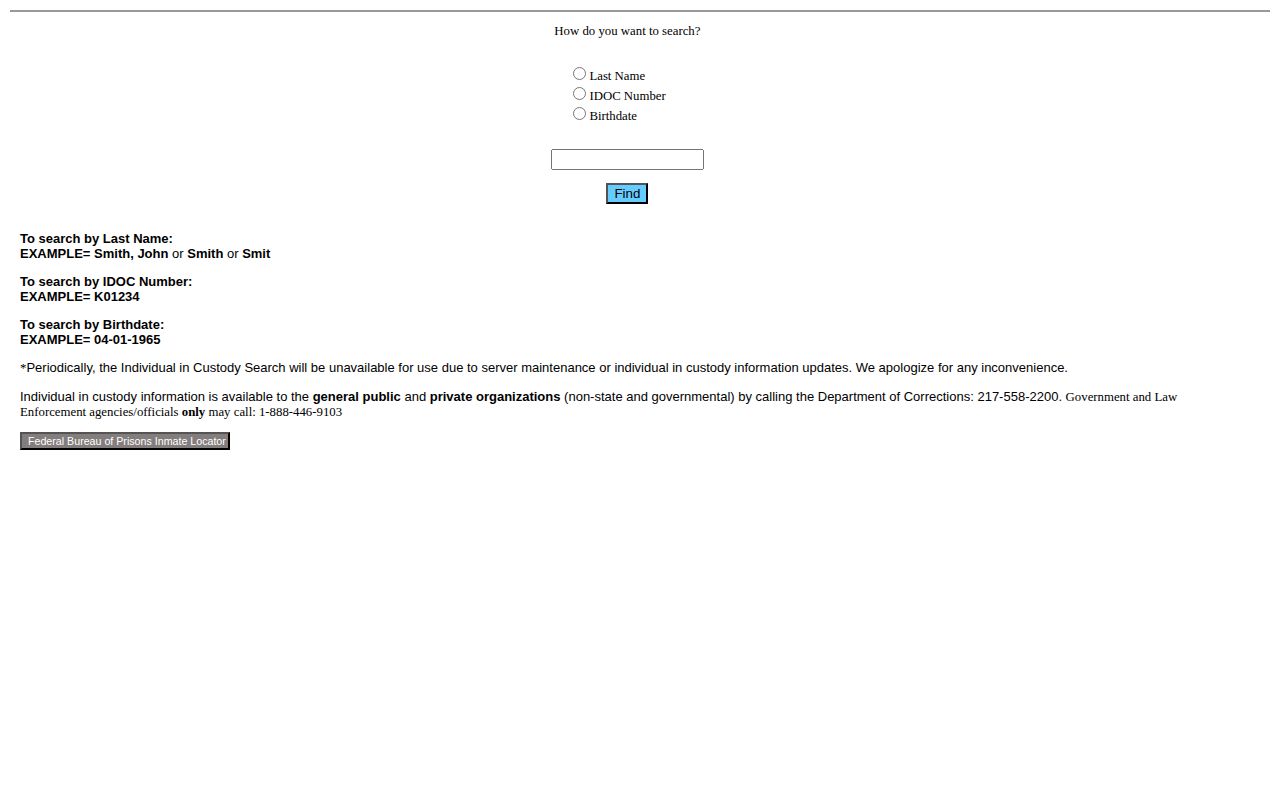
Use the returned profile's exact date fields, then compare them with the sentence and current status instead of relying on a copied date.
Kankakee Release Credit Rules
Illinois sentence dates are calculations, not a simple fraction applied to every term. 730 ILCS 5/3-6-3 governs sentence credit. The offense and sentence control the cap. Some terms receive one day of credit for each day served, often described as a 50 percent framework. Enumerated truth-in-sentencing offenses may require 85 percent, while some serious offenses require 100 percent. Other listed offenses have different limits. The record must identify the applicable provision before anyone can state a result.
730 ILCS 5/5-4.5-100 addresses custody credit and term calculation. Credit for time already spent in custody can affect the date. Program credit may apply only when earned and authorized. Discipline can cause credit loss. Because the offense class, count, custody date, mittimus, and statutory exclusions matter, an unofficial calculator should not be treated as IDOC's final answer.
IDOC's Docket/Release Card policy treats release-date entries as fields subject to recalculation. If a mittimus or court entry changes, send the correction to the agency that owns the calculation. Do not replace the state record with personal arithmetic.
Why Kankakee Release Dates Change
A projected date reflects the facts and credits known when the agency calculates it. Later events can move it. Save the retrieval date and the field label whenever a date is important. A newer completed event ordinarily carries more weight than an old projection.
| Factor | Possible effect | Record to check |
|---|---|---|
| Custody credit or court correction | Changes the credited start or term | Mittimus, court order, IDOC calculation |
| Earned or revoked credit | Moves the projected prison-release date | IDOC profile and release-card record |
| Detainer or another-county hold | May turn a local exit into a transfer | Sheriff transfer record and receiving agency |
| Parole or MSR action | Changes custody or supervision status | IDOC status and relevant PRB result |
| Multiple sentence counts | One discharged count may leave others active | Every sentence block and overall status |
| Processing after a court order | Actual exit may occur later than the order | Completed jail discharge timestamp |
A PRB hearing date is not a release date. Even a favorable decision must be reconciled with the IDOC profile to see whether it was carried out. Under 730 ILCS 5/3-3-3, parole and MSR operate within Illinois law, while 730 ILCS 5/5-8-1 addresses applicable MSR terms.
Confirm Kankakee Actual Release
Illinois VINE can send a notice based on data supplied by participating county, court, and state systems. Register against the correct person or case before the expected event and retain the alert text. Read “transfer” as transfer. It does not show return to the community. The Kankakee VINELink check covers the search, registration, and PIN sequence.
For county custody, the strongest proof is the Sheriff's completed discharge or transfer record. Ask for booking number, admission date and time, actual discharge or transfer date and time, release authority or type if recorded, and destination agency when transferred. The current Sheriff FOIA instructions require an email request to be placed in the message body. Attachments and embedded links are not processed. For state custody, confirm the updated IDOC profile and contact IDOC when an exact date is disputed.
When an alert and a custodian record differ, use the alert as a prompt to verify. Record the event type and time, then ask the Sheriff or IDOC for the completed event. A notice may reflect a downstream feed and lag a correction. The originating agency controls the underlying Kankakee County release date.
Note: Roster disappearance is not an actual release date; it may reflect transfer, a filter, or a record that no longer displays.
Kankakee Date Label Mismatches
The county's own pages show why labels must be preserved. The Sheriff landing page uses the broad phrase projected release date, while Tyler displays Scheduled Release Date. The detail record separates that from Release Date. IDOC then adds Parole Date and Projected Discharge Date. Turning all four into “release date” hides whether the value is an estimate, a prison exit to supervision, a county discharge, or the expected end of a commitment.
Write down the custodian, exact label, value, and retrieval date. If two records conflict, ask which agency owns each fact. The Circuit Clerk owns the order and judgment. The Sheriff owns county movement. IDOC owns its sentence calculation. VINE republishes notices and cannot correct the source record. That chain prevents a projected date from being repeated as a completed event.
The two Kankakee detention buildings add one more local issue. The 2024 inspection refers to work at both Jerome Combs Detention Center and Kankakee County Jail, but the public Tyler housing selector showed only Jerome Combs. A person missing from a facility filter may still be in the county system. Search by subject or booking number, then call Corrections before treating the missing facility choice as a release event.
Kankakee Release Date Records
When Tyler no longer returns a completed county booking, ask the Sheriff for an existing record instead of asking staff to calculate a date. A narrow request can seek the booking number, booking or admission time, actual discharge or transfer time, recorded authority or disposition, and receiving agency if custody continued elsewhere. Under Illinois FOIA, the response may redact or withhold protected material, but the office should cite the basis and consider whether nonexempt fields can be separated.
Prepare the full booked name, date of birth if safely known, subject number, arrest agency, intake range, and court docket. Do not send more personal data than needed. Email instructions on the current Sheriff page control over an older PDF: put the complete request in the email body and do not use attachments or embedded links. If the key issue is only release versus transfer, say so. A focused request is easier to locate and yields a clearer Kankakee County release-date record.
Kankakee IDOC Sentence Counts
An IDOC community profile can contain several sentence blocks. Each block may list the mittimus, offense class, count, offense, custody date, sentence, committing county, and a “Sentence Discharged?” value. Read them all. One Kankakee County count marked discharged does not establish that the overall commitment ended when another count remains active. The profile's overall Offender Status and Location control the broader interpretation.
A verified parole profile in the research showed PAROLE as the overall status, a parole-district location, Admission Date, Parole Date, and Projected Discharge Date. Together, those fields support release from prison to supervision on the Parole Date, with the commitment expected to end later. They do not support calling Projected Discharge Date the prison gate date. If the overall status changes after a violation or discharge, preserve the retrieval date so an older copy is not presented as current.
The committing-county field can link a sentence to Kankakee, but residence and supervision location answer different questions. A parolee living in Kankakee County may have been sentenced elsewhere. Conversely, a Kankakee sentence may be supervised in another district. Match the correct count and identity before attributing a projected release date to the county case.
Correct Kankakee Release Dates
Send a disputed date to the agency that owns it. The Sheriff controls county booking, discharge, and transfer entries. The Circuit Clerk controls filed orders, judgments, and docket entries. IDOC controls commitment calculations and its public profile. VINE receives source data and cannot amend the originating record. Sealing or expungement is also different from correcting an inaccurate date.
For an IDOC calculation issue, gather the mittimus and any later court correction. Use the proper legal or IDOC records channel instead of presenting a personal sentence-credit calculation as authoritative. The agency's Docket/Release Card directive shows that relevant entries can be revised as the official calculation changes. Ask which record supports the current field and when the next public update should appear.
If the court order and physical exit time differ, do not assume either is wrong. Processing, another warrant, a detainer, or a receiving agency can explain the gap. State the court's legal date and the custodian's completed movement time separately until the records reconcile.