
Jerome Combs Release Paths
Jerome Combs Detention Center, usually shortened to JCDC, is the primary Kankakee County jail building. Leaving its housing unit does not always mean returning to the community. A judge may authorize pretrial release, an older case may involve bond, or a county sentence may end after credit for time served. Those events can lead to a community discharge. A mittimus, which is the court order committing a person to prison, instead sends the person toward the Illinois Department of Corrections. Another county warrant, a federal order, or another agency hold can also keep custody in force after JCDC closes its booking.
The Sheriff custody record should identify the local exit. Ask whether the event was a discharge or transfer and whether a receiving agency was recorded. An actual date and time is stronger than a scheduled date shown while the booking remains open. If the destination is IDOC, search the statewide offender system after intake posts. If the destination is another jail or federal custody, follow that custodian. A roster disappearance alone supports only the cautious statement that the person is no longer visible in the live search.
Confirm a Jerome Combs Release
Begin with the Kankakee County Sheriff inmate-search page and follow its link to the Tyler public-safety interface. Search by the full name, subject number, or booking number. Save the identifiers, docket, court date, arrest agency, and the exact labels for Release Date and Scheduled Release Date. In testing on July 16, 2026, searches returned current-custody records even when the In Custody box was cleared. That observed limit means the interface should not be treated as a released-person archive.
- Check the live booking and record its subject and booking numbers.
- Review Illinois VINE for a custody-change alert tied to the same person or case.
- Open the Kankakee Circuit Clerk portal with the docket number to find the release order, disposition, sentence, or mittimus.
- Call Corrections and ask whether the booking remains in Kankakee physical custody.
- Request the completed Sheriff discharge or transfer record when exact proof matters.
The Kankakee County released-inmate search guide explains how these sources fit together. Court records show legal authority, not the jail movement log. VINE republishes agency data and may lag. The Sheriff remains the originator for the physical county exit.
Jerome Combs Record Request
A narrow written request is the best route when the completed booking no longer appears online. The current Sheriff FOIA instructions direct electronic requests to foiakcso@kankakeecountyil.gov and say the full request must be placed in the email body. Attachments and embedded links will not be opened or processed. In-person requests go to the Sheriff’s FOIA location at 3000 S. Justice Way, Kankakee, rather than to the Circuit Clerk courthouse office.
Identify the person as booked, the approximate intake date, booking or subject number, arrest agency, and docket if known. Request the admission date and time, actual discharge or transfer date and time, recorded release authority or disposition, and receiving agency if there was a transfer. Ask for the booking photograph separately if needed. Illinois FOIA identifies specified chronological arrest information, including the time an incarcerated person was received, discharged, or transferred, though statutory exemptions can permit withholding in defined cases.
Jerome Combs Detention Center
3050 S. Justice Way
Kankakee, IL 60901
Corrections:
815-802-7200
Sheriff: 815-802-7100
Telephone staff may confirm present custody but may decline to give a full historical account orally. Ask the closed question first: is this booking still held, and if not, was the exit a discharge or transfer? Use the written record for the exact timestamp and destination.
Jerome Combs Search Fields
The Tyler interface offers Name, Subject Number, Booking Number, an In Custody checkbox, booking-from and booking-to dates, and a Housing Facility selector. The selector observed in the research displayed Jerome Combs. Results can show scheduled release date, demographics, multiple-booking status, and housing facility. A booking detail may add Release Date, booking origin, prisoner type, charges, bond fields, docket, disposition, sentence data, arrest agency, and court information.
Those fields answer different questions. Scheduled Release Date is prospective and can change. Release Date is the stronger completed-event field when populated. A booking-date filter finds intake events, not everyone released during that span. A court disposition may explain why release was lawful, but it does not establish the time Corrections completed processing. Preserve each field’s exact label and the date it was retrieved.
The official Tyler search is shown below in its current-custody context.
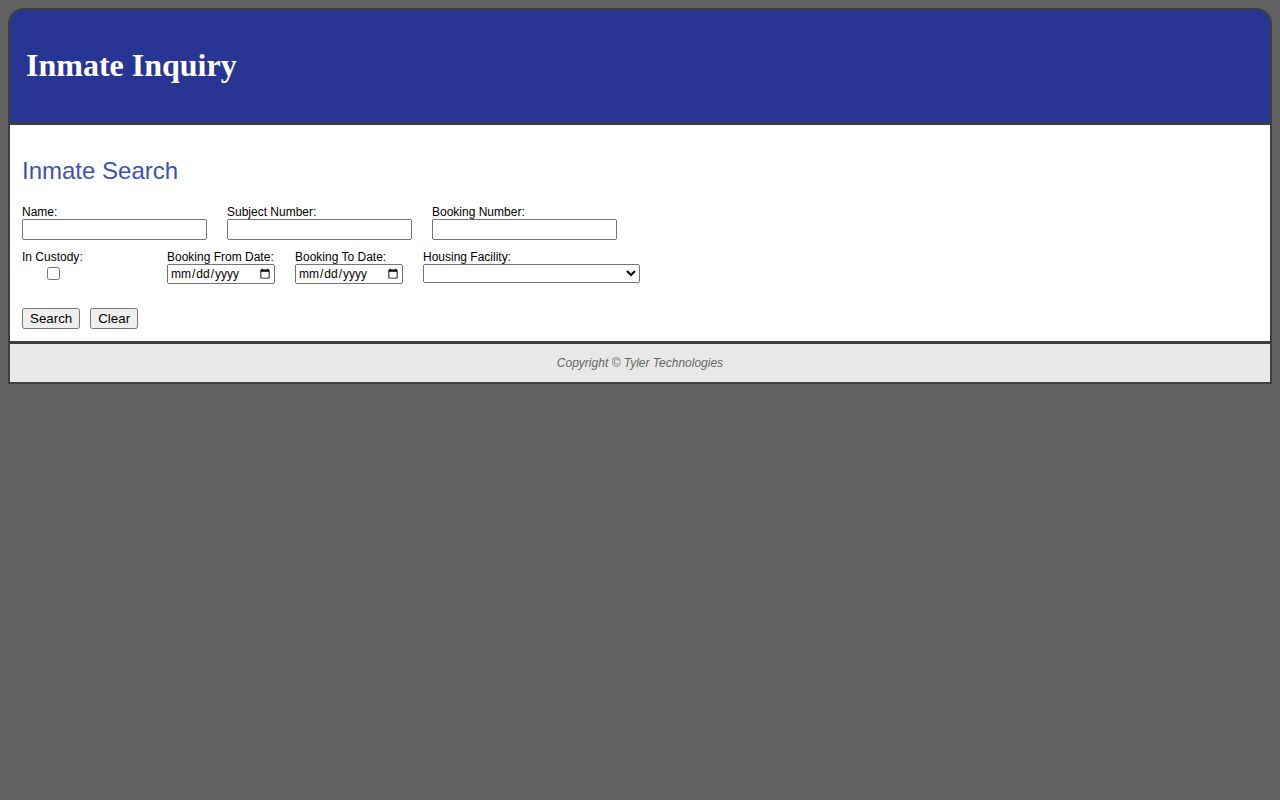
The screen is a fast starting point for a live JCDC booking. It does not replace a completed release or transfer record.
Jerome Combs Building History
The Sheriff’s detention-facilities history says JCDC opened on February 11, 2005. Its first phase was designed for 312 people. A second phase opened in 2007 with space for 144 more. Those are design and opening figures, not a claim about today’s confined population. The same Sheriff page discusses both JCDC and the older county detention center as parts of Kankakee’s local detention system.
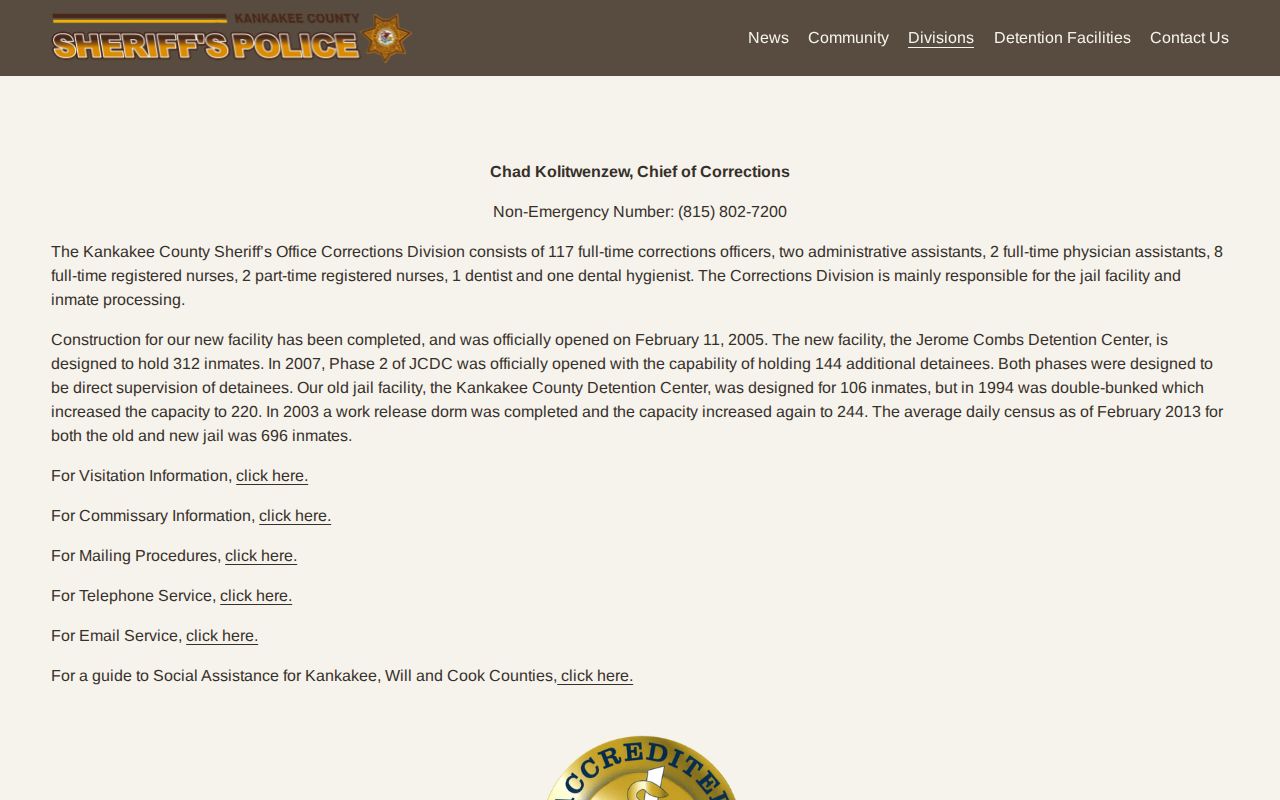
The two-building history matters because a person may be processed or housed within the county system even when the public selector shows only Jerome Combs. The 2024 IDOC jail inspection refers to activity at both JCDC and Kankakee County Jail, including video court and placement work. A facility filter is therefore not proof of the whole county custody picture.
The Sheriff’s page also gives an average daily census of 696 as of February 2013. That dated statistic provides historical scale only. It should never be presented as the current JCDC census or as a count of releases.
Jerome Combs Federal History
JCDC once held people under more than one sovereign. A 2020 ICE inspection documented adult male ICE detainees alongside United States Marshals Service and county populations. This is the distinctive detainer issue in older Jerome Combs records: a person could leave the local bed while remaining in federal or immigration custody. Transfer, removal, and community release must not be collapsed into one event.
Illinois later ended county ICE detention agreements. The remaining Kankakee ICE detainees were transferred out by February 4, 2022. Thus, Jerome Combs should not be described as a current ICE detention center. For an older federal placement, use the federal docket, USMS confirmation, BOP locator when BOP custody applies, or ICE records for immigration custody. “In transit” is movement, not release.
After a Jerome Combs Release
When the Sheriff record shows a community discharge, the court portal can clarify whether the basis was pretrial release, a completed sentence, dismissal, probation, or another order. Probation is a court sentence supervised locally. It differs from parole or mandatory supervised release, which follows an IDOC prison term. A person sent to IDOC has left JCDC but has not entered the community.
Kankakee County also has a code-based Sheriff reentry program. The ordinance describes a coordinator role that may help arrange transitional services before release and aftercare after release. Availability and individual eligibility require direct confirmation. The finding is still useful because it shows that local release planning is more than a timestamp, while avoiding any promise that a service will be provided in a specific case.
For the cleanest conclusion, compare independent records. A completed Sheriff timestamp proves the local physical exit. A matching court order supplies the legal basis. A VINE notice can provide timely notice. If the documents instead name a receiving agency, describe the event as a transfer and continue the search with that custodian.
Preserve the booking record before it drops from view. The subject number, booking number, docket, arrest agency, and exact scheduled-date label give each later office a common reference. If the court portal shows a release order but Corrections reports a later exit, check for another hold and the time required to process the order. If IDOC later shows admission, the sequence supports county-to-state transfer. When VINE announces a move, read its event text literally and search the destination. These steps also help correct errors: the Sheriff owns its movement time, the clerk owns the docket, IDOC owns the state profile, and VINE must receive a corrected feed from the originator.